
and the Kindness of Quiet Food
If my definition of comfort had to find a home in food that I have not been familiar with while growing up, this would be it.
Kerala stew and appam. It was love at first bite.
Growing up in a bengali household while also having a mother who’s a phenomenal chef is a blessing that not many of us have learnt to count. I realised the blessing when I first left home and flew down south. Missing home food had become a habit which I refused to grow fond of. In my many quests to find simple yet soul satisfying food in the city of Bangalore, I stumbled upon Koshy’s. Koshy’s need no introduction. For the uninitiated, Koshy’s is Indian Coffee House of Bangalore just with exponentially better food. And Koshy’s is where I fell in love with Kerala Stew.
While I have somewhat picked up on my mother’s culinary prowess, I must also admit I am an ardent lover of bland food. Not that I do not enjoy the occasional prawn ghee roast, or spicy King Fish rawa fry and the quintessential mutton kosha, my soul finds it peace in gentle food. I guess that is what intrigued me about Kerala stew. While carefully avoiding the road that leads to a riot of spices in shimmering oil, it landed right into my mouth with burst of insane flavours that were to last a lifetime. A Kerala stew is that friend who’d sit with you in your silence, as if saying, “take a bite whenever you are ready.” And perhaps that is why I took so long to understand it.
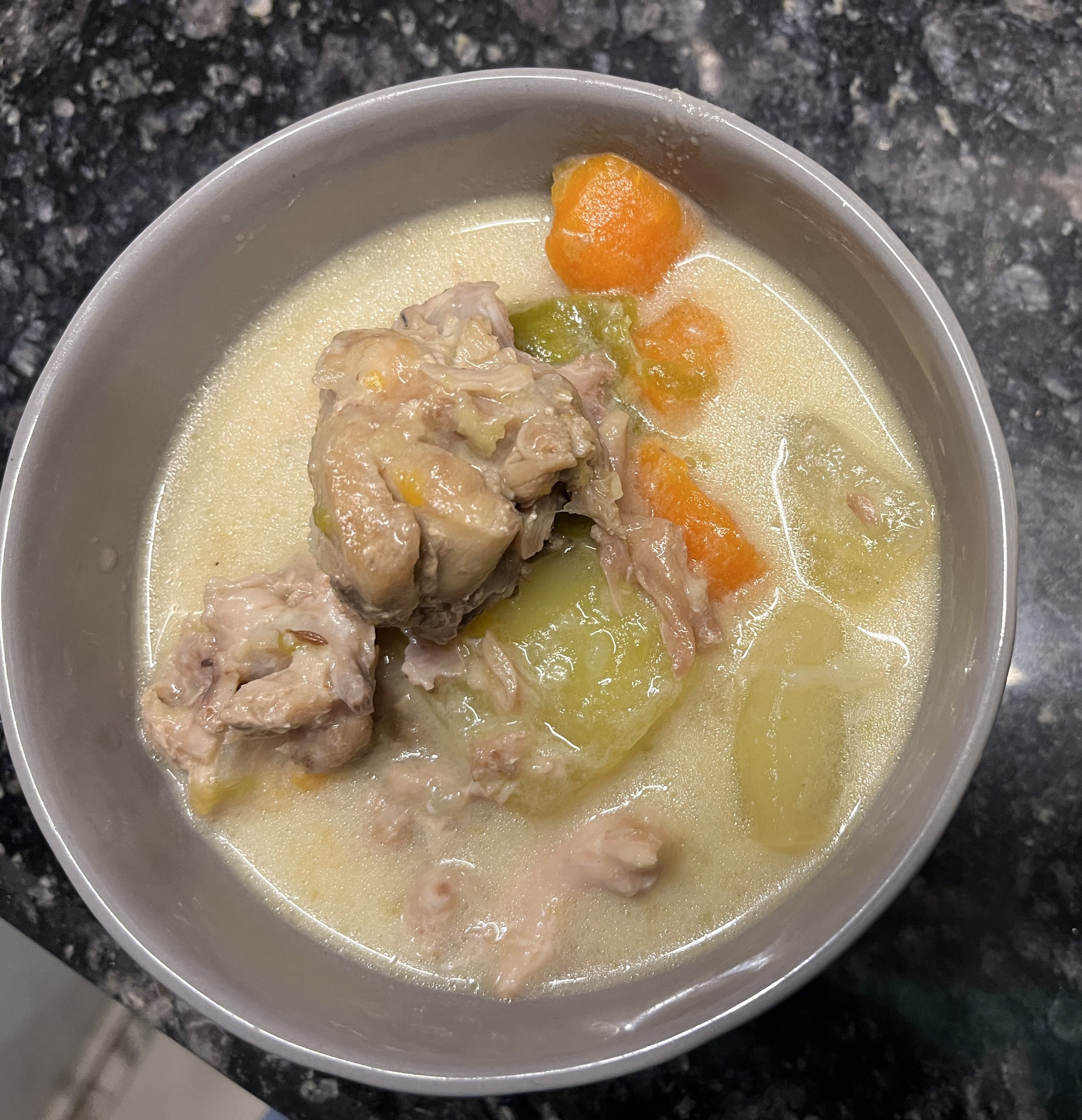
In my contrasting life meandering between shorshe jhaal and kosha mangshow, I found something that gave me the love of a kancha posto bata. The irony of a bland gentle dish is that they reveal themselves slowly, silently. As if the sweetness is not sweetness, it is the tender embrace of coconut milk wrapped itself around just perfectly cooked vegetables and chicken. The little black balls of pepper does not attack, rather they linger like a stray memory that found its way into your mid day leisure. A clove here, a cinnamon there, a hint of ginger – no rush. Nothing competes. Everything belongs. To the rainy mornings. The ones where you wake up before everyone else to the misty windows. To the melancholic nights. Where nobody is speaking because there isn’t anything urgent enough to disturb the silence.
Kerala Stew tastes like days and nights that still remember how to be slow.
I’ve always believed that recipes inherit personalities from the people who make them. Some recipes are dramatic. Some are stubborn. Some demand precision down to the last gram. Kerala Stew feels like that aunt who never interrupts anyone. She doesn’t speak much during family gatherings. She sits in one corner, peeling peas or shelling beans while everyone else argues over politics and cricket and some spicy gossip. But when someone quietly slips into the kitchen because life has become a little too much, she’s already pouring them a bowl. No questions. No lectures. No judgement. Just food. There is an incredible kindness in that. And perhaps that’s why this dish feels so different from so many other Indian curries. It has nothing to prove.
There is no elaborate masala patiently roasted for forty minutes. No endless list of powdered spices. No grand finale. Just coconut milk, pepper, ginger, onions, potatoes, vegetables or meat, whole spices, and time. The secret isn’t hidden in an expensive ingredient. The secret is restraint. Knowing when enough is enough. I sometimes think that’s a lesson many of us could borrow outside the kitchen too.
Food travels in curious ways. Kerala Stew is believed to have evolved through centuries of trade, colonial influence, and local ingenuity. Coconut milk had always been at home in Kerala, but European styles of stewing quietly found their way into local kitchens, eventually becoming something entirely their own. That’s the beautiful thing about food. Nobody owns it forever. It borrows. It adapts. It remembers. By the time it reaches our kitchens, it carries tiny stories from people we’ll never meet.
If you ask me what to eat with the Stew, the obvious answer is appam. Those feather-soft centres and lace-like crispy edges seem almost designed for this very purpose. They soak up every drop without losing themselves. But food is never about rules. I’ve happily eaten it with toasted bread on lazy evenings. I’ve mopped up the last spoonful with flaky malabar parottas. I’ve even been known to stand in the kitchen with a spoon and no accompaniment at all. Some combinations are traditional. Some are simply honest. And with food, I usually prefer honest.
The older I grow, the more I find myself returning to foods that whisper instead of shout. Maybe it’s because life has become noisy enough on its own. The constant notifications. The deadlines. The endless scrolling. Everyone competing to be seen. And then there’s a bowl of this Stew, quietly reminding you that gentleness can be memorable too. Not everything beautiful has to be loud. Not every meal has to overwhelm. Sometimes the greatest comfort comes dressed in white. And sometimes, the foods we almost overlook become the ones we carry with us the longest. Perhaps that’s the real recipe. Not coconut milk. Not pepper. Not cinnamon. Just enough kindness to make someone slow down for one meal. And somehow, that’s always enough.
Tell me about a dish that surprised you. The one you almost dismissed because it looked too simple, only to become one of your greatest comforts. I’d love to read your stories over a cup of tea.
With love,
Nuchi Nebu Nonka


Leave a Reply